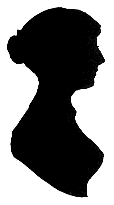
Jane Austen Info Page -- Short Table of Contents
(A short listing of the main categories of information on this site, and all e-texts; for a thorough listing, see the longer table of contents below.)
 Her writings: the six novels, and the minor works.
The following HTML e-texts are available here: Annotated and illustrated hypertext of Pride and
Prejudice.
Annotated and illustrated hypertext of Pride and
Prejudice.
- E-texts from her Juvenilia:
- Annotated hypertext of Love and
Freindship [satiric-humorous]
 Annotated text of The Three
Sisters [more serious]
Annotated text of Frederic
& Elfrida [satiric-humorous]
E-text of Jack & Alice [unrestrained Juvenilia]
E-text of Henry and Eliza [early humorous]
E-text of Lesley Castle (excerpts) [satiric-humorous]
Some further fragments of splendid nonsense from the Juvenilia
Annotated text of The Three
Sisters [more serious]
Annotated text of Frederic
& Elfrida [satiric-humorous]
E-text of Jack & Alice [unrestrained Juvenilia]
E-text of Henry and Eliza [early humorous]
E-text of Lesley Castle (excerpts) [satiric-humorous]
Some further fragments of splendid nonsense from the Juvenilia
- E-text of Lady
Susan [Jane Austen's wickedest tale]
E-text of The
Watsons [uncompleted novel]
- Miscellaneous excerpts from Northanger Abbey:
- E-text of Henry Tilney's gothic parody
E-text of Henry Tilney and Catherine Morland on marriage vs. dancing
E-text of The walk to Beechen Cliff (Henry and Eleanor Tilney with Catherine Morland)
- Sir Edward Denham's sense and literary taste (or lack thereof), from Sanditon
E-text of the Plan of a
Novel according to Hints from Various Quarters [satiric-humorous]
Opinions of Mansfield Park, collected by Jane Austen
E-texts of selected light verse
by Jane Austen.
E-texts of some poems on Jane
Austen.
- Jane Austen jokes:
 The "Jane Austen top ten song list".
The "Jane Austen punishments list".
"Photograph" of Jane Austen lounging at a Hollywood poolside <JPEG> (as seen in Entertainment Weekly).
The "Jane Austen top ten song list".
The "Jane Austen punishments list".
"Photograph" of Jane Austen lounging at a Hollywood poolside <JPEG> (as seen in Entertainment Weekly).
- Some failed pick-up lines from Jane Austen
E-text of Jane Austen's Letters (Brabourne edition)
- Famous quotes from the letters (or quotes that should be famous)
- Biography: Life (1775-1817) and Family.
- Jane Austen's Art and her Literary Reputation.
- Selective bibliography.
- Index of allusions to books and authors in Jane Austen's writings
- Bibliography of Jane Austen Sequels
- Full Bibliography of Books by Author.
- Full Bibliography of Books -- Subject Index.
- Bibliography of Articles and Dissertations: (A-G), (H-M), (N-?).
- Raw non-hierarchical menu of all HTML Files in this directory
- How to use this document.
Jane Austen Info Page -- Longer Table of Contents
- Writings.
Links on titles in the list below point towards brief discussions of each work (without intentional plot spoilers); other links point toward e-texts and miscellaneous available on-line resources.- Northanger Abbey
(published 1817).
- Pemberley e-text of Northanger Abbey (in chapters).
 Plain ASCII e-text of Northanger Abbey (available in uncompressed and compressed single-file versions from various Project Gutenberg sites).
- Henry Tilney's gothic parody
E-text of Henry Tilney and Catherine Morland on marriage vs. dancing
E-text of The walk to Beechen Cliff (Henry and Eleanor Tilney with Catherine Morland)
C. E. Brock illustrations for Northanger Abbey.
Summary of Northanger Abbey (with *spoilers*)
Chronology of Northanger Abbey (Ellen Moody)
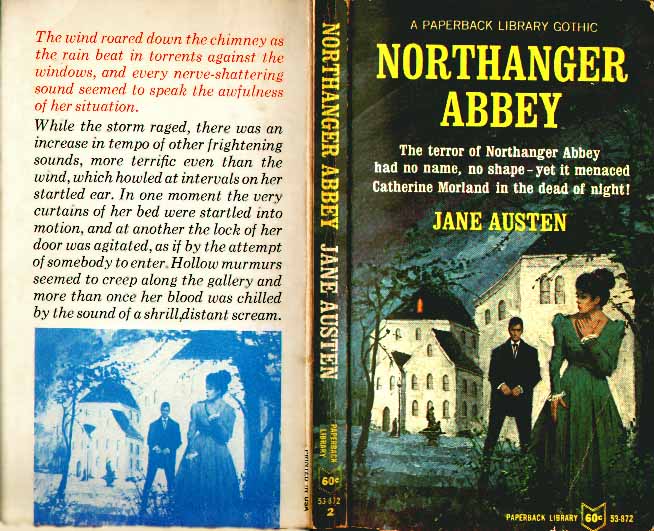
Silly cover of a printing of Northanger Abbey which was marketed as a gothic novel (USA, 1965) <JPEG>; Equally silly inside blurb; compare the puffed-up cover blurb with the original quote
- Sense and
Sensibility (published 1811).
- Pemberley e-text of Sense and Sensibility (divided into chapters).
Plain ASCII e-text of Sense and Sensibility (available in uncompressed and compressed single-file versions from various Project Gutenberg sites).
- Genealogy charts for the characters in Sense and Sensibility.
Notes on Sense and Sensibility.
C. E. Brock illustrations for Sense and Sensibility.
Penguin's Reader's Guide to Sense and Sensibility
Sense and Sensibility, the movie (official site); (other site)
- Pride and
Prejudice (published 1813).
- Annotated HTML Hypertext of Pride
and Prejudice.
- Chronology.
- List of characters.
- ...including Genealogical Charts
- List of passages illustrating the motifs of "pride" and "prejudice".
- Notes on random topics, including the society of Jane Austen's day.
- List of important places in Pride and Prejudice (and in Jane Austen's life), with map.
- 1895 Charles E. Brock illustrations for Pride and Prejudice [JPEG images] (includes notes on Regency clothing styles)
- Latest version of my plain ASCII e-text of Pride and Prejudice, compressed in binary .zip format <260577 bytes> [See explanation of ".zip" here.]
Pemberley e-text of Pride and Prejudice (in chapters).
- Mansfield Park (published 1814).
- Pemberley e-text of Mansfield Park (in chapters).
Plain ASCII e-text of Mansfield Park (available in uncompressed and compressed single-file versions from various Project Gutenberg sites).
- Opinions of Mansfield Park, collected by Jane Austen
- E-texts of Lovers' Vows by Kotzebue, translated by Inchbald:
- Lovers' Vows as it appeared in Chapman's edition of Mansfield Park
- Scholarly-edited text (with ponderous academic introduction)
A dialogue on the custom of girls' coming "Out"
Passages from Mansfield Park that detail Fanny Price's endearing imperfections
Program of a recent conference on Mansfield Park
Genealogical Charts for Mansfield Park
A chronology for Mansfield Park
A comparison between the characters Henry Crawford of Mansfield Park and Darcy of Pride and Prejudice
C. E. Brock illustrations for Mansfield Park (in color)
Funny cover illustration for a Spanish translation [.gif at Goucher College]
The definitive Fanny-bashing (if you can't top this, don't even bother trying to insult Fanny Price!)
What Fanny Price would have to do for some people not to find her "insipid"!
A concept illustration for a possible alternative ending to Mansfield Park (one that many people may find just as believable as Fanny getting together with Henry C.!  )
)
- E-texts of Lovers' Vows by Kotzebue, translated by Inchbald:
- Emma (published 1815).
- Pemberley e-text of Emma (divided into chapters).
- A sensual scene from Emma
The charades and riddle in Emma (with answers)
Genealogy charts for the characters in Emma
Chronology of Emma (Ellen Moody)
Kali's Emma page
The new TV version of Emma
Clueless, the Movie.
- Persuasion (published 1817).
- Pemberley e-text of Persuasion (in chapters).
Plain ASCII e-text of Persuasion (available in uncompressed and compressed single-file versions from various Project Gutenberg sites).
- The "cancelled chapters" of Persuasion
A list of all the occurences of the words "persuade"/"persuasion" in the novel
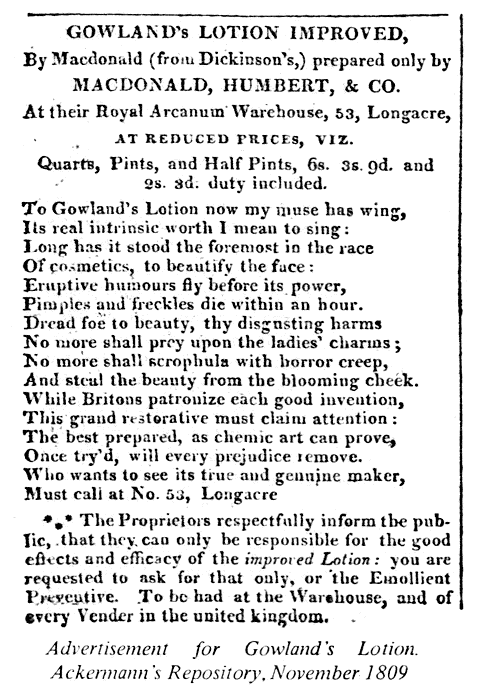
Advertisement for Gowlands' Lotion, from Ackermann's Repository 1809 (for ladies who want to carry away their freckles)
Genealogy charts for the characters in Persuasion
Chronology of Persuasion (Ellen Moody)
C. E. Brock illustrations for Persuasion.
Persuasion, the movie
- BBC and other Film/Video adaptations of Jane Austen's novels.
An article on the current wave of "Austenmania", including an interview with the producer of the new Sense and Sensibility film.- The Project Gutenberg e-texts of the novels are also available from various mirror sites; for more information (or in case you should, unaccountably, want e-texts of books not by Jane Austen), the best place to start is The On-line Books Page.
- Minor Writings.
- Her Juvenilia,
- Including Love and Freindship.
Annotated hypertext of Love and
Freindship
- Annotated text of The
Three Sisters
- Annotated text of Frederic
& Elfrida
- E-text of Jack & Alice
- E-text of Lesley Castle (excerpts)
- E-text of Henry and Eliza
- Some further fragments of splendid nonsense from the Juvenilia
(Includes: The Beautifull Cassandra,
Amelia Webster,
The Visit: A Comedy in 2 Acts, [Eugène Ionesco, eat your heart out!]
The Adventures of Mr. Harley,
A Beautiful Description of the Different Effects of Sensibility on Different Minds,
The History of England (excerpts), Letter From A Mother to her freind,
Letter from a Young lady crossed in Love to her freind,
The female philosopher -- A Letter,
A Letter from a Young Lady, whose feeling being too Strong for her Judgement, led her into the commission of Errors which her Heart disapproved,
A Tour through Wales in a Letter from a young Lady, and
The sad story of the beautiful Rose.)
Also: Sir William Mountague.
- Including Love and Freindship.
- Lady Susan
withe-text
andPlain ASCII e-text compressed in binary .zip format <49888 bytes> [See explanation of ".zip" here.]
- The Watsons
withe-text
andPlain ASCII e-text compressed in binary .zip format <39035 bytes> [See explanation of ".zip" here.]
- Sanditon
Sir Edward Denham's sense and literary taste (or lack thereof)
- The Plan of a Novel according to Hints from Various Quarters
withe-text.
- Her light verse
withmini-e-texts.
Some poems on Jane Austen.
- Northanger Abbey
(published 1817).
- Biography: Life (1775-1817) and Family.
- Her childhood and early creative work (Steventon, 1775-).
- Jane Austen's Brothers and Sister.
- Early adulthood at Steventon (-1801), and Bath (1801-1806).
- Maturity in Southampton (1806-1809) and Chawton (1806-1817).
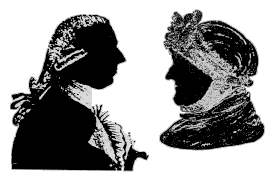
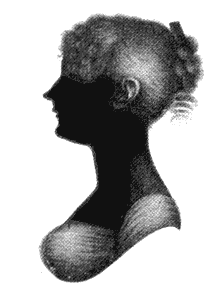
- Portraits of Jane Austen.
- Map of England, showing important places in Jane Austen's life (and in the novel Pride and Prejudice).
- E-text of Jane Austen's Letters (Brabourne edition)
- Notes on the society of Jane Austen's time
(especially with respect to Pride and
Prejudice).
- Education, Women's Education, and "Accomplishments".
- Marriage and the Alternatives: The Status of Women.
- Other historical notes:
- Jane Austen's Art and her Literary Reputation.
- Jane Austen's literary classification, and definitions of chronological periods
- Jane Austen's declarations on her own art.
- Diagram of Jane Austen's literary influences
- The "Defense of the Novel".
- Jane Austen's Limitations.
- Ellen Moody on Jane Austen's Heroes (from AUSTEN-L).
- Feminism in Jane Austen.
- Jane Austen's literary reputation.
- "Everybody loves their Jane Austen": occurrences of singular "their" etc. in Jane Austen's novels (Anti-pedantry page).
- On-line academic articles:
- Chronologies (calendars) of Jane Austen's works, by Ellen Moody.
- Other WWW pages on Jane Austen:
- Goucher College Library Jane Austen collection (includes bibliography, illustrations).
- Essays by Dom Nicholas
- Sony studios (in connection with the movie version of Persuasion)
- Sherry Dean (CNN)
- "Jane Austen Country" (County of Hampshire, England)
- The `Republic of Pemberley' (Jane Austen writings and adaptations discussion board site which hosts these Jane Austen pages)
- Jane Austen jokes:
- Selective bibliography.
- Index of allusions to books and authors in Jane Austen's writings
- Bibliography of Jane Austen Sequels
- Full Bibliography of Books by Author.
- Full Bibliography of Books -- Subject Index.
- Bibliography of Articles and Dissertations: (A-G), (H-M), (N-?).
- On-line Library Cataloging Information for the Jane Austen Information Page
- Some images:
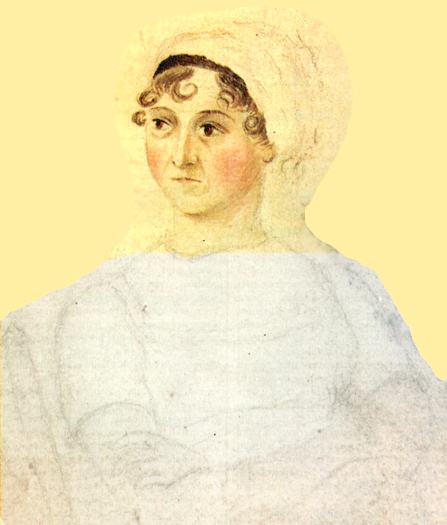
- Picture of Jane Austen <JPEG>
- The original incomplete (and somewhat unsatisfying) sketch of Jane Austen by her sister Cassandra (on which the above picture is based) <JPEG>
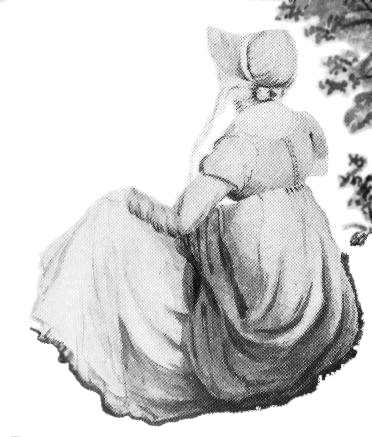
- Back-view
portrait of Jane Austen by Cassandra (poor-quality greyscale JPEG; a
poor-quality color JPEG is also available)
(See the discussion of these portraits.) - Portraits of other members of Austen's family:
- The Austen family coat of arms (Heraldic "blazon" or description: "Or, a chevron gules between three lions' gambs erect, erased sable armed of the second. Crest: on a mural crown or, a stag sejant argent, attired or."): original greyscale picture, rudimentary colorization. [Translation of Latin motto.]
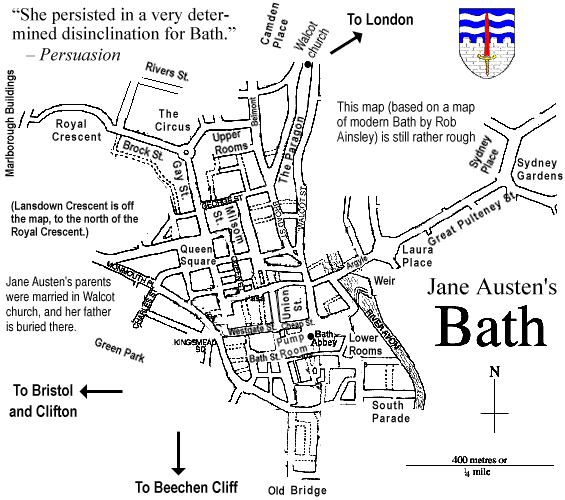
- Rough map of Bath ca. 1800
- The AUSTEN-L mailing list
- The most controversial topic on AUSTEN-L (not for the faint of heart! -- this has caused great contention and debate on the list)
- Some apparently common misconceptions of Jane Austen and her characters
- The Jane Austen Society
- An MSNBC article on Jane Austen's cyber-fandom (including AUSTEN-L and this web-site)
- Raw non-hierarchical menu of all HTML Files in this directory
- Caveats.
- How to use this document.
![[New]](new.gif)

 Go to the top of this info page.
 Go to
Pride & Prejudice hypertext.
Go to
Pride & Prejudice hypertext.