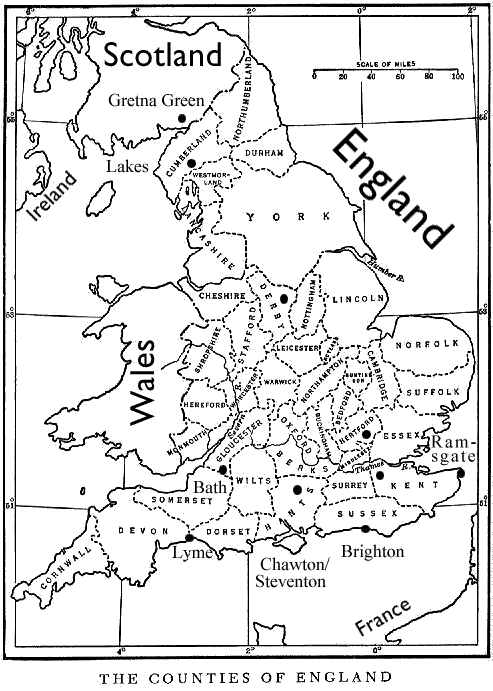
On the
map
a black dot is placed on the
three counties in which most of the action of the novel occurs, and several
other places in the novel were marked where there was room on the map
On the southeast coast the town of
Brighton is the
fashionable sea-side resort, with a temporary military camp, where
Lydia goes. In real life it was the
hangout of the Prince Regent and his
decadent coterie; in a letter of January 8th 1799 to
Cassandra, Jane
Austen wrote "I assure you that I dread the idea of going to Brighton as
much as you do, but I am not without hopes that something may happen to
prevent it". Eastbourne is another seaside town on
the Sussex coast, to the east of Brighton.
"Here I am once more in this scene of
dissipation and vice, and I begin already to find my morals corrupted."
-- Jane Austen, letter of August 1796
London is not marked on
the map, since there was no room to do so (it is southeastern Middlesex). The
London area had over a million inhabitants (the first city in Europe to do
so), and was several times larger than any other city in Britain; London was
often associated, in the imagination of Jane
Austen's day, with loose morals in both low life and high society -- a
scene of fashionable dissipations and a dangerous example to the rest of the
country (thus the opportunistic and amoral
Lady Susan says
"London will always be the fairest field of
action, however my views may be directed"). Bromley is
between Westerham and London,
Epsom is on the
southern-eastern approaches to London, and
Clapham is a neighbourhood
on the south side of the Thames (across from the `City' proper).
Cheapside, where the
Bingley sisters accuse Mr. Gardiner of living (he actually lives in
Gracechurch Street, further east) is an
unfashionably commercial neighbourhood in the
`City', near St. Paul's. Grosvenor street, where Mr. Hurst and Louisa
live, is in a much more fashionable neighborhood towards the West End.
Barnet and
Hatfield are coaching
stations to the north of London, through which
Lydia and
Wickham would probably have passed
if they had been going to Scotland.
The Lake country (rugged,
scenic, and with literary associations) is in the far northwest of England;
and Newcastle (where
Wickham is stationed after his
marriage to Lydia) is in
Northumberland in the northeast. Gretna Green, just
over the Scottish border, was the Nevada of its day (taking advantage of the
laxer Scottish marriage laws during the 1754-1856 period) -- quickie
marriages, minors don't need parental permission, few questions asked.
According to Caroline Norton, "Gretna" was "not... of itself a city sacred to Hymen, but the nearest village
across the boundary of England, that could be reached by enamoured couples".
In Gloucester/Somerset:
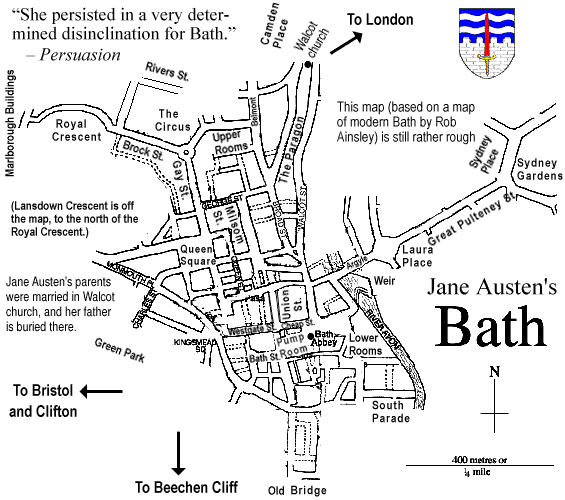
Bath (marked on the
map) was a health resort, retirement town, and provincial outpost of
fashionable life; Jane Austen's parents were married there, she lived
there 1801-1806, and her father is buried there. Bath had been fashionable with
high society (Beau Nash and his dandies) earlier in the 18th century,
but had become less so by Jane Austen's day.
Bath is important in her novels
Northanger Abbey and
Persuasion (and has a minor
`off-stage' rôle in Mansfield
Park), though it was not Jane Austen's favorite place to live in
("Bath is still Bath", as she wrote in a
letter of November 6, 1813). Clifton, in which Jane
Austen lived briefly in 1806, and which is the target of one of Catherine
Morland's excursions in Northanger
Abbey, is near Bristol, towards the coast northwest of
Bath.
The seaside town of
Lyme was visited by
Jane Austen in 1803-1804, and plays a significant
rôle in the novel
Persuasion. Her possible
tragically-ended early 1800's affair of the
heart occurred along the Devonshire coast, west of
Lyme.
 Important Places in Pride and Prejudice and Jane Austen's Life -- Map


 is placed on the
three counties in which most of the action of the novel occurs, and several
other places in the novel were marked where there was room on the map
is placed on the
three counties in which most of the action of the novel occurs, and several
other places in the novel were marked where there was room on the map


 Go to
Go to